Showing posts with label sad. Show all posts

Tuesday, February 13, 2024

One less Un*xy option for 32-bit PowerPC

Most of you still using a Power Mac as a daily or occasional driver are probably either running Linux, Tiger or Leopard, and a minority on OS 9. Despite many distributions no longer shipping 32-bit PPC installs, Gentoo Linux still has specific support along with a few others, as does Adélie Linux if you like musl for breakfast. Still, for server duties, where I come from, you bring on the BSDs. In this blog you've already met my long-suffering NetBSD Macintosh IIci which is still trucking to this day and more recently my also-NetBSD G4 Mac mini (which later needed, effectively, a logic board swap), but I also have a Quadra 605 with a full '040 running NetBSD I use for utility tasks and at one time I ran an intermediate incarnation of gopher.floodgap.com on a Power Macintosh 7300 with a Sonnet G3 running NetBSD too. I stuffed that system full with a gig of RAM and a SATA card and it did very well until I got the current POWER6 server in 2010.

NetBSD has the widest support, continuing to run on most 68Ks and PCI Power Macs to this day (leaving out only the NuBus Power Macs which aren't really supported by much of anything anymore, sadly). However, OpenBSD works fine on New World Macs, and FreeBSD has a very mature 32-bit PowerPC port — or, should I say, soon will have had one, since starting in FreeBSD 15 (13.x is the current release), ARMv6, 32-bit Intel and 32-bit PowerPC support will likely be removed. No new 32-bit support will be added, including for RISC-V.

Even though I have a large number of NetBSD systems, I still like FreeBSD, and one of my remote "island" systems runs it. The differences between BSDs are more subtle than with Linux distributions, but you can still enjoy the different flavours that result, and I even ported a little FreeBSD code to the NetBSD kernel so I could support automatic restarts after a power failure on the G4 mini. The fact that the userland and kernel are better matched together probably makes the BSDs better desktop clients, too, especially since on big-endian we're already used to some packages just not building right, so we don't lose a whole lot by running it. (Usually those are the same packages that wouldn't build on anything but Linux anyway.)

This isn't the end for the G5, which should still be able to run the 64-bit version of FreeBSD, and OpenBSD hasn't voiced any firm plans to cut 32-bit loose. However, NetBSD supports the widest range of Macs, including Macs far older than any Power Mac, and frankly if you want to use a Un*x on a Power Mac and have reasonable confidence it will still be running on it for years to come, it's undeniably the one with the best track record.

Monday, September 24, 2018

R.I.P., Charles W. Moore, a fine man who liked fine Macs

A farewell and au revoir to a great gentleman in making the most of your old Mac, Charles W. Moore, who passed away at his home in rural Canada on September 16 after a long illness. Mr Moore was an early fan of TenFourFox, even back in the old bad Firefox 4 beta days, and he really made his famous Pismo PowerBook G3 systems work hard for it. Charles definitely was of the same mind I think a lot of our readers here are: "Even after going on a decade and a half, I still find them [his Pismos] a pleasure to use within the context of what they’re still good at." I'm sure most of us will agree the same is true for any classic computer in general and particularly Power Macs as a whole given how underwhelming Apple's current Mac offerings are. While later on he upgraded to a 17" Big Al, and although I admire the Pismo my favourite Mac laptop to this day remains the wonderfully customizable PowerBook 1400 (with a G3/466, thank you very much, and still looking for a solar cover!), I can think of few people who bore the standard of the classic Mac as a useful productivity device for as long as he did. Even old tools can still be the right tools when given the right job to do.

Go with God.

Tuesday, August 8, 2017

And now for several things that are completely different: Vintage Computer Festival aftermath, I pass a POWER9 kidneystone, and isindex isdead which issad

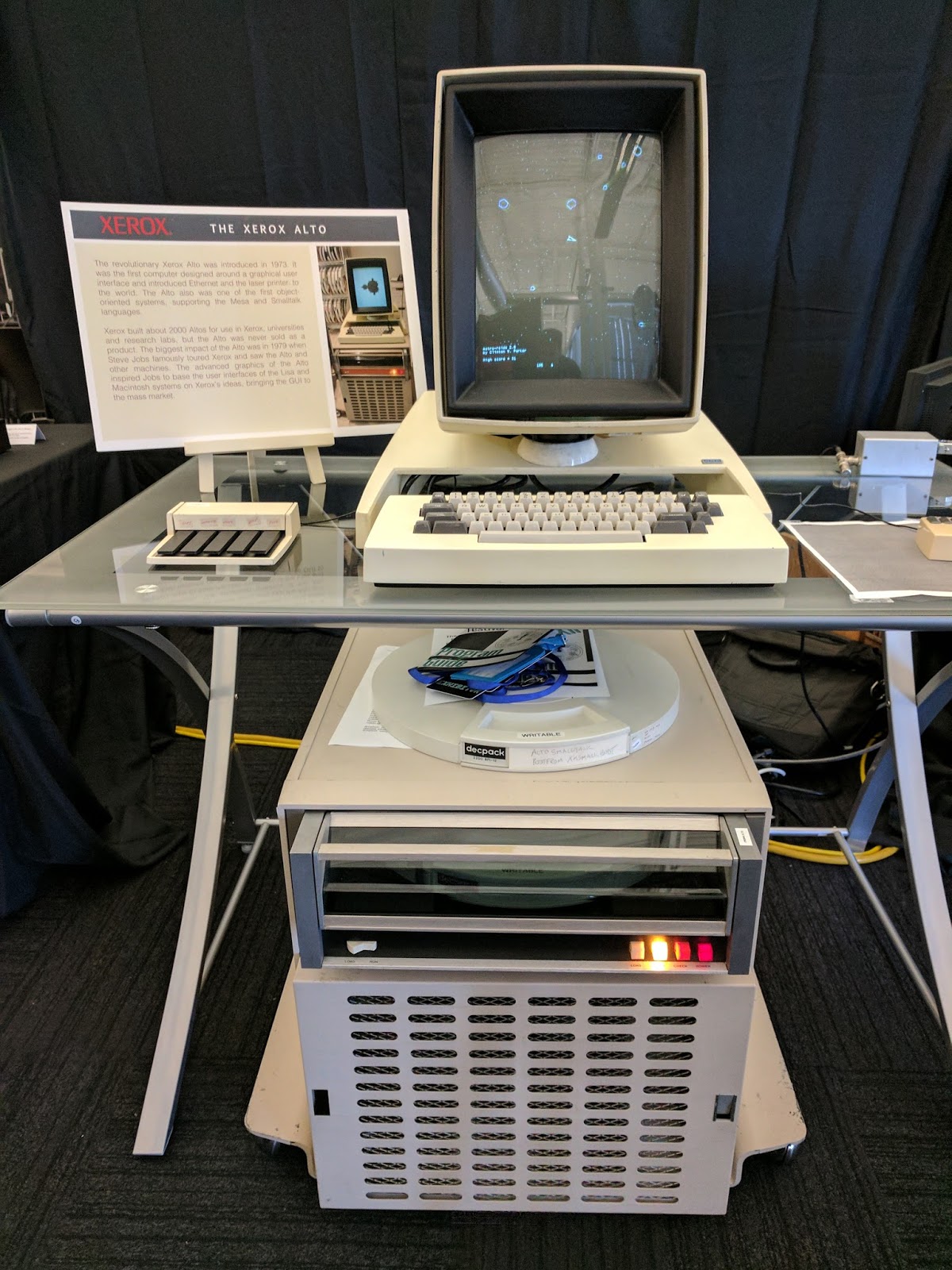
So, you slugs who didn't drag yourselves to the Computer History Museum in Mountain View for this year's Vintage Computer Festival West, here's what you didn't see (and here's what you didn't see last year).

You didn't see me cram two dorm refrigerator-sized Apple servers and a CRT monitor into my Honda Civic,

you didn't see my Apple Network Server exhibit, complete with a Shiner HE prototype and twin PowerBook 2300 Duos and an Outbound notebook serving as clients,
you didn't see a functioning Xerox Alto,
you didn't see SDF's original AT&T 3B2,
you didn't see Bil Herd, Leonard Tramiel and other old Commodore luminaries talking about then and now,
you didn't see a replica "CADET" IBM 1620, "just as it was" in 1959 (the infamous system that used lookup tables for addition rather than a proper adder, hence the acronym's alternative expansion as "Can't Add, Doesn't Even Try"),
you didn't see a JLPGA PowerBook 170 signed by John Sculley,
you didn't see a prototype dual G4 PowerBook,
you didn't see a prototype Mac mini with an iPod dock (and an amusing FAIL sticker),
you didn't see components from the Cray-1 supercomputer,
you didn't see this 6502-based astrology system in the consignment section, of the same model used by Nancy Reagan's astrologer Joan Quigley,
and you didn't see me investigate this Gbike parked out front, possibly against company policy.
You could have, if you had come. But now it's too late. Try again next year.

But what you still have a chance to see is your very own Talos II POWER9 workstation under your desk, because preorders opened today. Now, a reminder: I don't work for Raptor, I don't get any money from Raptor, and I paid retail; I'm just a fairly intransigent PowerPC bigot who is willing to put my Visa card where my mouth is.

Currently on its way to my doorstep is a two-CPU, octocore (each core is SMT-4, so that's 32 threads) Sforza POWER9 Talos II with 32GB of DDR4 ECC RAM, an AMD Radeon Pro WX7100, a 500GB NVMe SSD and an LSI 9300 8-port internal SAS controller. The system comes standard with a case, eight SAS/SATA bays, EATX motherboard, fans for each CPU, dual 1400W redundant PSUs, USB 3.0 and 2.0, RS-232, VGA, Blu-ray optical drive, dual Gigabit Ethernet, five PCIe slots (PCIe 4.0, 3 x16 and 2 x8) and a recovery disc. It runs Linux on ppc64le, which is fully supported. The total cost shipped to my maildrop with a hex driver for the high-speed fan assemblies is $7236.

Now, some of you are hyperventilating by now and a few of you may have gone into frank sticker shock. Before you reach for the Xanax, please remember this is most assuredly not a commodity x86_64 machine; this is a different (and Power ISA successor) architecture with fully auditable firmware, the ability for you to do your own upgrades and service with off-the-shelf parts, and no binary blobs with hidden spies like the Intel Management Engine. This is a niche box for people like us who value alternative architectures, especially in a design that we can build and trust ourselves, and I always said something like this wouldn't come cheap. But let's compare and say you're in the market for a Mac Pro or something. You'll still be paying a lot, especially if you get any of the tasty BTO options, and the next Mac Pro is still months away or more. And if you were actually in the market for an AmigaOne X5000, this blows it out of the water. You could just run UAE on this and have cycles to spare!

When the Talos II arrives, I'll be sure to post some unboxing photos and take it through its paces on first boot and give you some initial impressions. My immediate goal is to get a RAID set up, get QEMU able to run a decent subset of my old Mac software (I'll probably start with OS 9, and then create a Tiger instance or clone the G5 to it), and get Firefox running with compiler settings appropriate to the CPU. Then will come the real fun of writing a JavaScript JIT for POWER9.

But don't worry: the G5 isn't going anywhere and neither is TenFourFox. I've got a lot invested in this Quad and it will still be serving workstation duty for awhile yet. Nevertheless, get your credit card and your intestinal fortitude out in the meantime and reserve a Talos of your own while the pre-order period is open. Time to get in while it's hot. This is the next evolutionary step in personal computing with PowerPC.

As we wind up our discussion of the future, however, one part of the past will soon be almost completely gone: the venerable old <isindex> HTML tag. Firefox will be removing it from 56 for technical reasons after it was already removed from Google Chrome and the Safari preview. This construct dates back to the very earliest days of the Web when early browsers didn't have form support; it was designed as an easy way of enabling the user to send search keywords or parameters to a webserver, much like Gopher servers receive queries over item type 7. Mosaic 1.x even had a little form that was a permanent part of the browser chrome with a search button, as you can see from the screenshot at the Macintosh Repository, which would be activated when the tag was seen. Later on, subsequent versions of Mosaic and most of the successor browsers turned it into a pseudo-form that functioned the same way as far as the server is concerned and some of those sites are still around. Myself I use the tag mostly as a convenience for old browsers and Lynx on the Hytelnet-HTTP gateway; the search system offers both a conventional search form and an <isindex> query, both of which work the same, and both of which can still be seen in 52ESR, 54 and the 55 beta for the time being. It goes without saying that I will not be removing it from TenFourFox, and it will eternally remain in our codebase and on my servers as a relic of the way things were and an echo of the way the early Web was.

Friday, August 4, 2017

And now for something completely different: when good Mac apps go bought

The Unarchiver, one of the more handy tools for, uh, unarchiving, um, archives, is now a commercial app. 3.11.1 can run on 10.4 PowerPC, but the "legacy" download they offer has a defective resource fork, and the source code is no longer available.

The same author also wrote an image display tool called Xee. 2.2 would run on 10.4 PowerPC. After Unarchiver's purchase, it seems Xee was part of the same deal and now only Xee 3 is available.

Fortunately my inveterate digital hoarding habit came in handy, because I managed to get both a working archive of The Unarchiver 3.11.1 and Xee 2.2 and the source code, so I can try to maintain them for our older platforms. (Xee I have compiling and running happily; Unarchiver will need a little work, but it's doable.) But that's kind of the trick, isn't it? If I hadn't thought to grab these and their source code a number of months ago as part of my standard operating procedure, they'd be gone, probably forever. I'm sure MacPaw (the new owners) are good people but I don't foresee them putting any time in to toss a bone to legacy Power Macs, let alone actually continue support. When these things happen without warning to a long-time open source free utility, that's even worse.

That said, the X Lossless Decoder, which I use regularly to rip CDs and change audio formats and did donate to, is still trucking along. Here's a real Universal app: it runs on any system from 10.4 to 10.12, on PowerPC or Intel, and the latest version of July 29, 2017 actually fixes a Tiger PowerPC bug. I'm getting worried about its future on our old machines, though: it's a 32-bit Intel app, and Apple has ominously said High Sierra "will be the last macOS release to support 32-bit apps without compromise." They haven't said what they mean by that, but my guess is that 10.14 might be the first release where Intel 32-bit Carbon apps either no longer run or have certain features disabled, and it's very possible 10.15 might not run any 32-bit applications (Carbon or Cocoa) at all. It might be possible to build 64-bit Intel and still lipo it with a 32-bit PowerPC executable, but these are the kinds of situations that get previously working configurations tossed in the eff-it bucket, especially if the code bases for each side of the fat binary end up diverging substantially. I guess I'd better grab a source snapshot too just in case.

As these long lived apps founder and obsolesce, if you want to something kept right, you keep it yourself.

Saturday, March 25, 2017

45.9.0b1 available

TenFourFox 45.9.0 beta 1 is now available (downloads, hashes). This version continues deploying more of the multiple microoptimizations started with 45.8, including rescheduling xptcall which is the glue used for calling XPCOM functions (use CTR instead of LR for branching, reorder instructions to eliminate register and FXU dependencies), more reduced branches, hoisting call loads earlier in code sequences, optimized arithmetic inline caches for both Baseline and Ion code generation (especially integer operations for division, min/max and absolute value), fixing a stupid bug which used a branchy way of doing logical comparisons on floating point values (this passed tests but was unnecessarily inefficient), and eliminating some irrelevant branches in font runs and graphics. While I was at it I cherrypicked a few other minor perf boosts from 46 and stuck those in as well.

Also, the font blacklist is updated (fixing Apple and Medium) along with new support for blocking ATSUI-incompatible data:font/* URLs, and there is a speculative fix for the long-running issue of making changing the default search engine stick (this is difficult for me to test because none of my systems seem to be affected). The guts for repairing geolocation are in this version too but I'm still dithering over the service; most likely we will use the Mozilla Location Service though I'm open to other suggestions. Remember that the only sensor data Power Macs can provide for geolocation out of the box is the WiFi SSIDs they see (but this is perfectly sufficient for MLS). This should be finalized by the time 45.9 goes to release.

For FPR1, the first feature I'm planning to implement is one that was cancelled for 45 during beta: Brotli compression, which on supported sites can reduce data transfer by 14 to 39 percent with little impact on decompression time. This will involve backporting the current Brotli decompressor from 52ESR and then making necessary changes to Necko to support it, but happily much of the work was already done before it was disabled (for a critical bug that could not be easily worked around at the time) and released in 46. If there is sufficient time, I'd also like to implement the "New Hot NSS" (get it?) and backport the NSS security and encryption library from 52ESR as well, both of which will also reduce the burden of backporting security fixes. That's a bit of a bigger job, though, and might be FPR2 territory. Other major want-to-dos will be some JavaScript ES6 features I predict will be commonly used in the near future like Unicode regexes and changes to function scoping, both of which landed in 46 and should be easy to add to 45.

Only one site has been reported as incompatible with our plan to shut down SHA-1 certificate support with FPR1. As mentioned, it would take a major site failure for me to call this plan off, but I'd still like as much testing as possible beforehand. If you haven't done it already, please go into about:config and switch security.pki.sha1_enforcement_level to 1, and report any sites that fail. This approach of complete decommissioning is essentially the same policy Google Chrome will be taking, and soon no major browser will accept SHA-1 certificates as trusted for TLS, so it's not like we're going out on a limb here. Please note that reversing this change will not be a supported configuration because (the security implications notwithstanding) it may be un-possible to allow doing so after the new NSS library is eventually transplanted in.

Once 45.9 comes out, we will switch to our own Github repository and the source code will be uploaded and maintained from there (no more changeset overlays!). However, pull requests won't be accepted unless they're tied to an issue already accepted on the worklist, and we will still enforce the policy that non-contributor bug reports need to be triaged through Tenderapp first. Watch for the repo's magical population shortly after 45.9's final release on April 18.

Unfortunately, I don't think there will be a Tenfourbird FPR1: it appears that our anonymous colleague in the Land of the Rising Sun has not made any builds since 38.9, and that is a real shame. :(

Friday, March 17, 2017

45.8.1 not available (also: 45.9 and FPR1 progress, and goodbye, App.net)

TenFourFox 45.8.1 is not available, because there isn't one, even though Firefox 52.0.1 is available to fix the fallout from Pwn2Own. However, the exploited API in question does not exist in Firefox 45 (against which we are based) and a second attack against Firefox was apparently unsuccessful, so at least right now no urgent TenFourFox chemspill is required. 45.9, the last release we will make at source parity against the Mozilla code base, is still on schedule for April 18th.

45.9 has more microimprovements to JavaScript, including some sections of hand-written assembly code that have been completely overhauled (especially in the inline caches for arithmetic operations) and fixing a stupid bug that caused logical comparisons on floating point operations to always hit a slow code path, some additional microimprovements to hard-coding code flow with xptcall, graphics and text runs, and then bug fixes for geolocation and the font blacklist. The last two should be done by the end of next week or slightly after, and then after I test it internally there will be a beta prior to release.

Today, though, I've been playing with Google's new Guetzli JPEG encoder, which promises higher compression ratios with great quality that any JPEG decoder can view, because you really can have "tastes great" and "less filling" at the same time, apparently. Yes, I was able to get it to compile on the Power Mac and it works pretty well on my G5 from the command line; I'm trying to package it as a drag-and-drop tool which I might release a little later if I have time. If Guetzli takes off, maybe Google will stop it with their stupid WebP fetish since this is a much better solution and far more compatible.

Finally, yesterday was the last day of App.net, fondly called "ADN" by denizens such as myself, Martin, Sevan and Riccardo. It unfairly got tarred as a "pay Twitter clone," which in fairness its operators didn't do enough to dispel, though most of us longtimers think that the service sealed its doom when they moved from a strictly pay model to a freemium model. That then destabilized the service by allowing a tier of user that wasn't really invested in its long-term success (like, say, blog spammers, etc.), and it gradually dropped below profitability because the pay tier didn't offer enough at that point.

But ADN had a real sense of community that just doesn't exist with Facebook, nor Twitter in particular. There were much fewer trolls and mob packs, and those that did engage in that behaviour found themselves ostracised quickly. Furthermore, you didn't have the sense of people breathing down your neck or endlessly searching for victims who might post the wrong thing so they can harass and "out" you for not toeing the party line. I think the smaller surface area and user base really led to that kind of healthier online relating, and I still believe that a social media service that forces a smaller number of people to be invested in the success of that service -- that in turn treats them as customers and not cattle -- is the most effective way to get around the problems the large free social sites have.

Meanwhile, most of us ADN refugees have moved to Pnut, made by another ADN denizen. Pnut is getting around the jerk problem by going invite-only. If you're not a jerk and you're interested in a better community to socially interact online, contact me and I'll get you a code.

Here are the last moments of the ADN global stream, as witnessed by Texapp, my custom ADN client. Thanks, Dalton and Bryan, and all the great ADN staff that participated over the years. It was a good ride while it lasted.